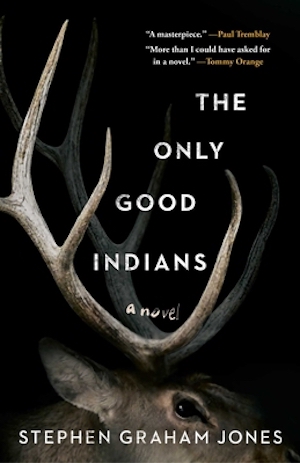
The Only Good Indians
in a nutshell: Four young men from a Blackfeet reservation sneak onto the elder's territory after an unsuccessful day of hunting, only to encounter an entire herd of elk on the forbidden land. They kill as many as they can shoot, but one female elk refuses to die. Shooting her in the head, they realize she is pregnant. Their shame leads them to cut out and bury the calf, swearing aloud to the dead elk mother that every bit of meat will be eaten. Decades later, a tribal elder dies with uneaten meat still in his freezer. Now living separate lives, one by one the four men are unknowingly visited by a vengeful spirit that takes different forms, orchestrating twisted horrors in their lives to exact total, bloody revenge.
the vibes: The book is split into different sections detailing the haunting/hunting of each of the cursed men, and to me, the sections took on different tones akin to different genres: haunting, possession, stalking, and even a final girl hunt to the death. But the vibes remained cohesive, like there is one elder telling you this chilling tale at a campfire in a dark woods.
main themes: Cultural honor and duty, brotherhood, colonial horror, what makes a man, Blackfeet and Native heritage, fatherhood, ecohorror and sacred land, what we owe to the animals and the territory we continuously take from, violence against Native women, the American myths of elk.
the writing: Damned good, and scary as shit. The characters are vibrant and believable, exploring thematic elements that might be too much in the hands of a lesser writer but are expertly threaded into a tale of bloodthirsty revenge that leaves you chilled and apologetic to the soil of a land you might never have traversed. Every discussion I found of this book on forums, mentioned the halfway point of the book as a holy shit! moment that fully sucked the reader in.
"The land claims what you leave behind."
A Blackfleet Nation man stumbles out of a bar one night, and is stopped by strange sounds. In the parking lot ahead, a giant elk runs between the parked cars, thrashing its horns into the steel frames, smashing glass windows. The commotion draws out a group of hick barflies, white men angry to discover a single Indian standing alone in the middle of their vehicles, and a violent hunt ensues.
Elsewhere, far from the reservation they grew up on, another Blackfeet man is wrestling with cultural guilt at the remembrance of a violent hunt in his youth. He keeps this from his white wife, as he begins to see visions of slain elk and suffer nightmares of blood. With his mind loosening, he starts to cast his suspicions on his wife, then on his Indian coworker, a young woman who seems to intuit what is wrong with him. He lashes out more and more, as he feels the spirit of something closing in on him, demanding that blood be spilled.
A fetus stirs, an elk calf. It begins a slow journey on a winter road. As it makes its way towards its destination, it begins to change, to take on the shape of something else.
Still on the reservation, two grown men have remained friends through the trials of fatherhood and broken relationships. They are contracted to build a sweat lodge and host a sweat for the local police chief's younger son, who needs to be reminded of his heritage. They send the women in their lives off so they can host the sweat on a cold winter night, unknowingly surrounded by something that has come to end them.
"An elk mother, cornered, will slash with her hooves and tear with her mouth and even offer the hope of her own hamstrings, and if none of that works, she'll rise again years and years later, because it's never over, it's always just beginning again."
This book gripped me from the start. I felt very invested in the elk's revenge, but also wished the men could overcome their issues with warring definitions of manhood, the weight of cultural duty, and failed desire to be "Good Indians" (in whose eyes?), and somehow make it out alive. Jones is not afraid to get bloody as fuck, and there was some great body horror and scenes that made me gasp aloud in shock. When the elk orchestrated two of the men turning on one another, I genuinely grieved for their shattered friendships and lives. Hope I'm not giving away too much, because I promise whatever I've written, this book contains so much more.
Even though I could not personally relate to the grander thematic elements, they were presented in such a bonedeep way I found myself really pondering them over the days after I finished this book. How what you inherit culturally can also haunt you if you feel you've failed to live up to it, even if that failure was traded for the opportunity to succeed in a different way (in the colonizer's way.) What must it be like to live on your ancestor's land, but it's not their land? It's yours, but it's not yours, and there is no shortage of other men unwilling to let you forget that fact. You're raised calling the land one thing, but everyone else calls it America. It's to exist in different worlds, to exist to different degrees in each world, to have so many warring elements within yourself and within others' definitions of you. It must feel like a haunting. Like your very being is supernatural.
I appreciated that Jones takes care to elevate the powers of keeping tradition while showing the virtues-- and even just the possibility-- of breaking cycles. Also, everything about the Elk Woman (a mythology I was not familiar with) is rad as hell. And if the idea of an elk doesn't sound scary to you, trust me, Jones has created a very, very scary spirit here.
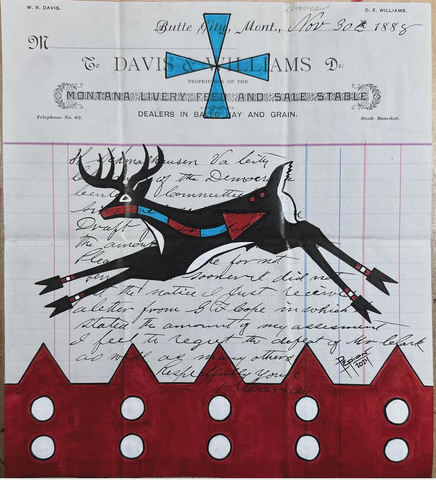
Artwork used here is by John Isaiah Pepion of the Piikuni Blackfeet Nation in Montana. The style is known as ledger art and was originally popular amongst Native American artists from Plains tribes in the 1800s.