
Death Takes Me
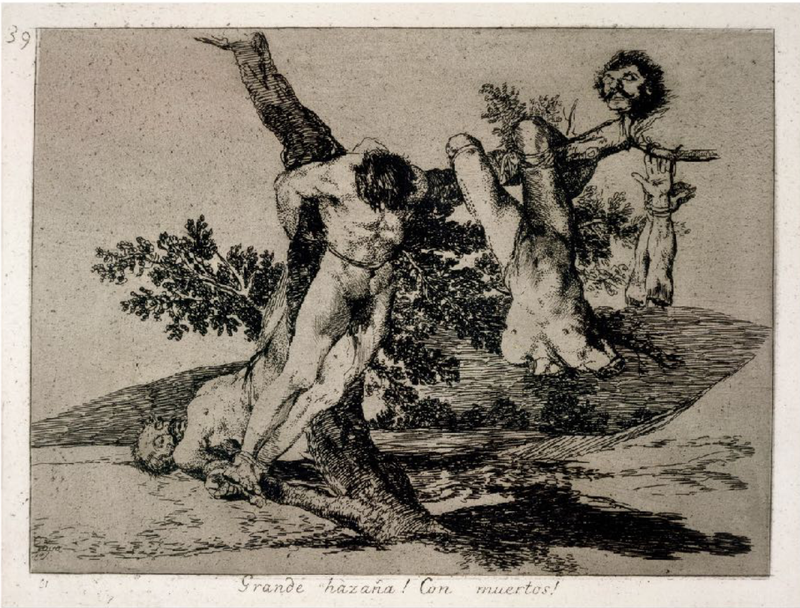
From Goya's 'The Disasters of War' series
in a nutshell: A very metafictional and hyper intertextual serial killer-vs-detective novel exploring femicide and language, with one section an academic essay on the literary struggles of the writer Alejandra Pizarnik, one section comprised of a series of poems, and a shifting, dark narrative that moves between the voices of a Professor (named Cristina Rivera Garza) who discovers the first body in a series of murdered and castrated men, the Detective assigned to the case who becomes increasingly obsessed with the poetry of Pizarnik due to the murderess leaving snippets of Pizarnik's poems near the bodies, and the murderess herself (themself?) whose epistolary chapters veer into almost-love letters left for the Professor. The Professor grows evermore intrigued by the stoic Detective, who enlists the Professor's help in understanding poetry while growing suspicious of her proximity to the case, and the enamored murderess can't stop reaching out to the Professor. Outside of this bizarre (love?) triangle are the men in these women's lives (and beds) and a young tabloid journalist who wants to write a book about the Case of the Castrated Men in a bid to lend her writing legitimacy in her own eyes. Also, a healthy heaping of contemporary art!
the vibes: Nonlinear violence and thoughts on violence interspersed with poetry; the social eruption of the intimate; Marina Abramovic; the Other; obsessions; what is it, truly, to murder something? "Quien habla? Quien carajos habla?" Who is speaking? Who the hell is speaking?" --Pizarnik (but really, with the narrators shifting so frequently, who the hell is speaking)
main themes: Examination of gendered violence (originally written in Spanish, where the word for 'victim' is always feminine); the futile but inexorable struggle for interpretation and understanding, vis-a-vis violence, language, man to woman, I to myself; meditations on gender, identity, and boundaries both imagined and bodily; A City is Always a Cemetery; castration as metaphor / a threat / a tragedy / true equality; every poem is a failure; Desire with a capital 'D'.
the writing: Polemic, to be sure: I think readers will either dig it or ditch it half-way through. Via passages from Pizarnik's diary, Rivera Garza all but outright states that this work is intended to defy interpretation. There is much ruminating on the threads and fences between poetry and prose, with the novel swimming between the two not only on a chapter level but at the sentence level. The hydra of the three women narrators makes it difficult to know who is 'she' as none of them use an 'I' but it achieves an intellectually engaging effect that I suspect Rivera Garza was going for. Far from a traditional whodunnit, so don't invest if you want those kinds of answers, but if you're down to experience (and I use that verb pointedly) a serial killer narrative from a very labyrinthine, prismatic view, then please give this a whirl! Recommended more for fans of Bhanu Kapil than Gillian Flynn.
This is a book to feel not "understand."
This novel(?) is so nontraditional that I don't even know how to 'review' it, and to try to sum it up seems a disservice (or an outright murder, according to Rivera Garza.) Instead I'll just ramble a little on what I liked about it: the use of contemporary art, all the poetry, and especially Rivera Garza's challenging meditations on language. I wasn't familiar with Alejandra Pizarnik, the tragic Argentine poet whose words are left at the crime scenes (scrawled in lipstick, coral nail polish, and arranged in stones among other methods) but her diary entries about her chaotic internal struggle to write a book in prose, as in: To Be Understood, made for very interesting parallel reading. Being so intertextual, this book required me to continuously put it down in order to seek out the essays, the artworks, and philosophers either alluded to or quoted throughout it. & I am very much a bitch who adores self-assigned homework, so it was a blast to do so, even if I'm not erudite or generally smart enough to 'get' half of the texts. Anyway, here we go!
The Art
The murderer/ess never reveals their true identity, instead signing their letters to the Professor with the names of various performance artists: Abramovic, Gina Pane, and Lynn Hershman Leeson. Each of the artists' pieces referenced in the book made me pause and noodle to myself on how they were meant to be in conversation with the narrative, which added an extra dimension to the experience of reading which I very much enjoyed. At least, I'm pretty sure these are the pieces, as Rivera Garza only alludes to or describes bits of the works. We have, in this murder mystery, a gallery displaying:

Balkan Baroque
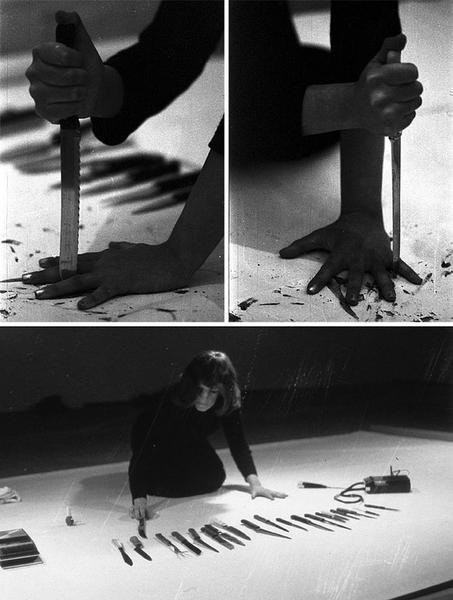
Abramovic's 'Balkan Baroque,' 'Rhythm 10,' and 'The Great Wall Walk'
Gina Pane's 'Action Psyche' and 'Burying A Ray of Sunlight'
Lynne Hershman Leeson's 'Seduction' from The Phantom Limb series
"If I open my 'body' so that you can see your blood therein, it is for love of you, the Other." - Gina Pane
What I took from these pieces being "displayed" together, alongside Pizarnik's words, (& again, according to the book itself I am not supposed to attempt interpretation so much as feel it) was Rivera Garza's imploring us to digest the immediate act and effects of violence. If we don't experience a certain violence done to us, or to those closest to us, the distance so alters our understanding of the violence as to make the understanding itself impossible. Pizarnik is a writer who is "writing in-this-moment." Abramovic is interested in art that "disturbs its viewer and sparks a moment of danger... as such, the audience has no choice but to live in the here and now." Pane's work strives to reach the Other, with such a desperation that she repeatedly spilled her own blood and inflicted great bodily pain upon herself to induce recognition in her viewers with not just herself, but fellow humans across the globe. Hershman lived in alter egos for years, eventually hiring other performers to also be those alters, simultaneously, blurring the lines of identity and how society builds an understanding of a life via what evidence is left behind.
"The philosophy of death is made for us by its proximity." - Vladimir Jankelevitch
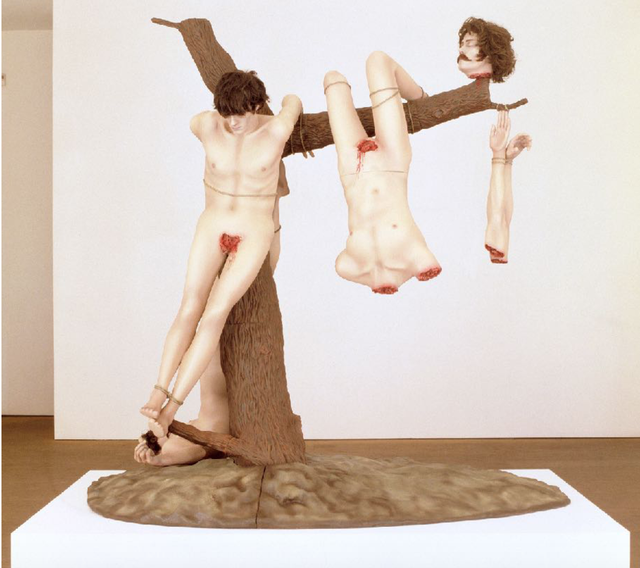
Rivera Garza (the Professor) is shaken from stumbling upon "her first body," and later finds the murder scene brings to mind her recent viewing of the Chapman brothers' work 'Great Deeds Against the Dead.' This allegorical work is famously itself an appropriation of a plate from Goya's historic series, 'The Disasters of War' titled 'Grande hazaña! Con muertos!' The roles of the spectator, the act of replication, the intentions behind purposefully generating shock-- all of these float through the reader's mind as the Professor worries herself out of sleep.
The Poetry
As stated, I hadn't encountered Alejandra Pizarnik's work previously but, like the Detective, the more I learned, the further in love I fell with this "idiosyncratic and thematically introspective" writer. According to her Wikipedia page, she left us "one of the most unusual bodies of work in Latin American literature", which has been recognized and celebrated for its fixation on "the limitation of language, silence, the body, night, the nature of intimacy, madness, [and] death". WELL. Thematically, that seems right up Rivera Garza's alley, and Pizarnik could not be more relevant a ghost to haunt this tale.
Among the snippets of her poems found at the crime scenes, the first seems to hold the most "clues:"
take care of me my love
beware of the silent one in the desert
of the traveler with the empty glass
and from the shadow of his shadow
The section of the book that takes the form of a long academic essay on Pizarnik's fraught relationship with language-- specifically her attempts to bridge her work from poetry to prose-- drew heavily from Pizarnik's own diary. She laments her inability to be as precise as she'd like, as succinct, as clear as needed to be understood. Towards the end of her frustrations with this challenge, Pizarnik writes a declaration that Rivera Garza pointedly quotes, and is obviously a metacritique directed at the reader of 'Death Takes Me:'
Rhythm 10
The Language
This is a serial killer mystery about language: the boundaries of language, the violence of language, the futility of language, and (though not quite in English) the gender of language.
The epigraph of the book is a quote from one Renata Salecl: "However, with humans, castration should not be understood as the basis for denying the possibility of the sexual relationship, but as the prerequisite for any sexual relation at all. It can even be said that it is only because subjects are castrated that human relations as such can exist."
Knowing nothing about Salecl (beyond the innate knowledge that, if asked to pronounce her name, I'd fuck it up) I had to do some digging, because my initial surface-level reading of this quote would be that it is pro-castration. Well, turns out, Salecl is a Lacanian philosopher, so read through the lens of Lacan's theory, castration here is not a bodily mutilation but an intellectual one, castration as limitation on language, thereby effecting limitations on culture and societal norms. This info completely shifted my mindset for how to read/experience this book. If certain paragraphs confused me, some sentences seemed strange bedfellows, then this was an intended effect. Any meanings are castrated, unreachable, and only in that way could they be intimately personable.

Action Psyche
"THOSE WHO VERSIFY DON'T VERIFY"
My favorite notion Garza Rivera works with is the idea of murdering something, but in a nontraditional sense. Each of her characters feels they are dissembling the life of a thing by dissecting the thing itself.
The Detective feels guilt over repeatedly autopsying the victims' bodies, as well as the intimate details of their lives: "she'll sniff inside the body just like the murderer... she'll kill them a second time. The Detective must wring out those dead finish those dead torture those dead to find the thread that ties them to their executioner. That's what embarrasses her: having to kill the bodies she examines." As the Detective learns to 'read' poetry, falling deeper into the trance cast by Pizarnik's words, she begins to understand this act is akin to the autopsies: "As she reads, the Detective pronounces the word Belgrade. She does it so many times that the word eventually loses its meaning. Belgrade. Now the word is just a light concentration of letters. Barely a chain of sounds. A dismemberment in the making."
As the Professor looks more and more like the perfect "suspectress" to the homicide department, she even begins to suspect herself: "Didn't she have, as the expert in serial killers had put it, and unhealthy interest in looking inside? Wouldn't that interest suffice to open the wound? And wasn't that, at the end of the day, what writing is?"
In the end, the murderess names it plainly in one of her creepy missives:
I wondered why Rivera Garza would name the Professor character identically to herself. Was it self-admonishment/critique of the field of linguistics, a gesture towards its limits in the harsh world we live in every day? I do know she won a Pulitzer for her memoir, Liliana's Invincible Summer, about her sister who was murdered at 20 years old by her ex-boyfriend. The murderer was never brought to justice. So femicide, living without clarity, absence of answers, are things Rivera Garza (the author) lives with herself. Perhaps attempting a social critique via a lack of definitive statements is not what she intended with this book, but rather to make us, the readers, simply sit in it. To feel it. But, I don't want to wonder too hard, I might myself become a killer.
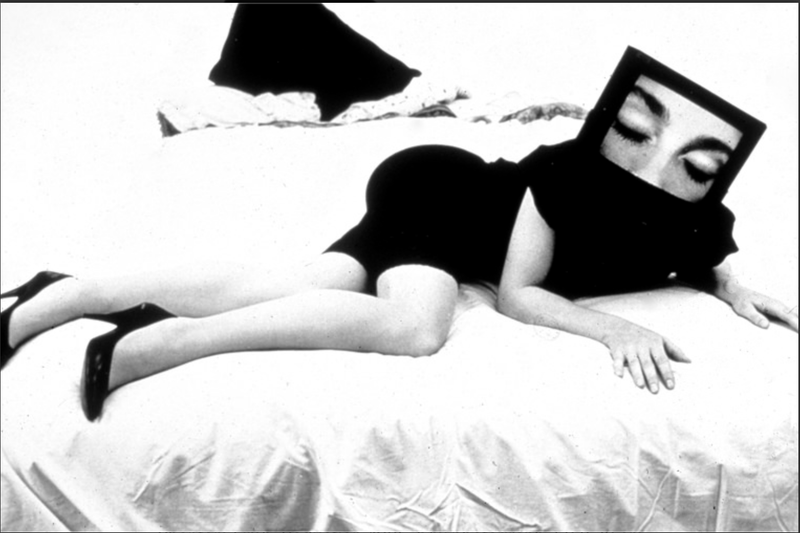
'Seduction' Lynne Hershman'