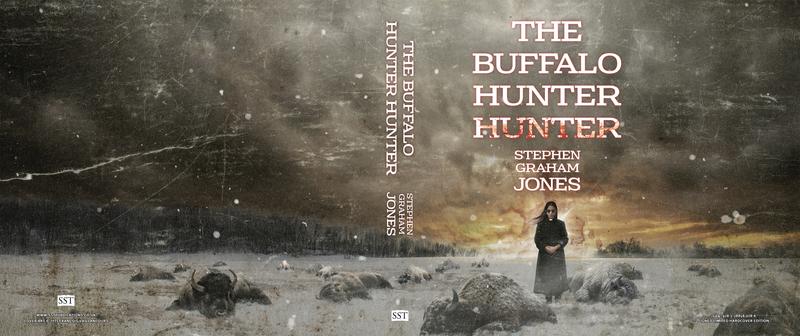
The Buffalo Hunter Hunter
in a nutshell: 2012, a construction worker pulls a weathered journal out of a wall in Montana, and the only living relative of its author begins to transcribe its crumbling pages. 1912, a weathered pastor records his days in Miles City on the Montana frontier, where the skinned bodies of strange men begin appearing on the edges of town. 1870, a handful of Blackfeet men come upon an eerie scene littered with colonial soldiers' remains, and one terrifying god-like creature that smells of death. 1912, an Indian man in peculiar garb arrives at the pastor's pinewood church, and the two begin to meet for 'confession,' wherein the Indian promises the pastor will-- by the end of his increasingly horrifying and wild tale-- come to believe that everything he speaks is true. 2012, the woman transcribing her great-great-great-great grandfather's journal finds herself haunted by what she reads, as she realizes neither her pastor relative nor his Indian visitor are anything like what they seem.
main themes: MONSTERS, those with fangs and those with flags; what do we become when we are cut off from our heritage; gluttony; blood; revenge; inherited violence of colonialism; becoming different people over the course of one's life (but do we ever truly change); animalism
the vibes: Yes, vampires in the wild west / Indian American revenge horror, but so much more. A Frankenstein-esque triple nesting-doll narrative framework that allows the larger mysteries and horrors to creep up and unravel across a 100+ year span, tickling the reader's brain and keeping them guessing (while also enjoying knowing the terror that's coming when the narrators don't.) The sensory nature of the tale had me alternatively convinced that the room was too bright and too dark to read in. This book grabs you by the bones with its sharp teeth and you feel the story in a bodily way.
the writing: SGJ fucking brought it on this one. The voices of all three narrators are so distinct. Etsy, our 2012 transcriber, begins her project with great excitement, then mentally and spiritually unravels as she makes her way through the journal. Her mounting anxiety and fear really ramp up the vibes for a heck of a gnarly ending. The plains and mountains felt vividly alive in the Blackfeet Good Stab's narrative, teeming with four-legs running wild and living gods sleeping in caves. I love that SGJ freely uses indigenous words without explanation, and just like the pastor and Etsy, I eventually found myself thinking of the words outside of the narrative (spotted a few mice in the park and thought to myself, 'dirty-faces.') The pastor's journal entries cast light and shadow over the author's true intentions, keeping him a frustratingly and engagingly slippery character you can't tell if you pity or loathe. His sense of humor keeps things lighter, in sharp contrast to Good Stab's extremely painful and bloody life story. Having these two very different characters in conversation is where the tale really shines. Bit by bit, confession by confession, they become one another's narrative doppelgangers, entangled together with an inevitable end that points to one's destruction at the hands of the other.
2012
Etsy (Betsy without a B, I guess) is desperate for a tenure-granting project to publish, so she leaps at the chance to transcribe and publish her great-great-great-great-grandfather's newly discovered journal. As the soon-to-be last living descendant (a soon-to-be important fact) of one Arthur Beaucarne, she gets first dibs at unraveling the tale told in his 100-yr-old spidery handwriting, and a lot more than she bargained for once her place in the tale becomes more evident. A century may separate her from Arthur and Good Stab, but we do not choose what we inherit by blood, only what we do with it.
1912, Arthur Beaucarne, a.k.a. Three-Persons
"That was a different man in a different life, not me."
Arthur Beaucarne is a 60-something kindly man whose passion to lead a flock of souls to righteousness brings him to a frontier town in the new state of Montana. In his writings, he initially comes off as an earnest if flawed soul who alludes to a sinful past that he is hoping to earn retribution for, while still struggling with "failure of temperance." He is, in secret, a glutton, incapable of willpower when it comes to consumption of sweets and the communal wine. But he believes he is ultimately a man doing good, regardless of the dark things he may have done to arrive where he is. He holds the same to be true for the growing young nation of America.
1870 + 1912, Good Stab, a.k.a. Fullblood
"...each step to avoid your fate is but a step closer to it."
Good Stab is a man of the Small Robes tribe of the Blackfeet nation, who encounters a god in the mountains, makes a selfish decision, and is changed forever. 30 years later he begins to meet with an old pastor in secret, to share his wild, terrifying tale of everything he has seen and done since. Where Arthur's narrative voice is written as a journal, Good Stab speaks as if around a fire, weaving a tale directly to his listener. The dialogue of these "confessions" is a true stand out for a book full of memorable elements: arguments over complicity, meditations on intention, justifications of violence-- these two characters travel far together in their discussions.
The Buffalo Hunter Hunter a.k.a. Takes No Scalps
"What I am is the Indian who can't die. I'm the worst dream America ever had."
During the years Good Stab lives in Nittowsinan as a vampire, his main struggle is not survival but identity. His Pikuni heritage is of the utmost importance to him, but after his transformation he is cut off from his tribe and their ways of life. He cannot dream, eat real-meat, smoke from his father's pipe, or sire children-- all important pillars of Pikuni life. He learns not to cry for loss of blood, hardening his heart and turning away from all human connection.
While pursuing trackers, he comes across a massacre: a field of skinned buffalo bodies left to rot while their starving cubs cry amongst their dead family. Incensed, Good Stab violently kills the buffalo hunters and skinners, beginning his life as Takes No Scalps, the avenger of the buffalo and revenge of the Indians.
The Cat Man, a.k.a. 'The vampire'
Good Stab does not know the word 'vampire' and describes the humanesque creature he encounters as a 'white god,' a 'cat man' bearing fangs and attacking with supernatural agility. SGJ has spoken about his desire to write his own take on vampires, one less aristocratic and charming and more feral and animalistic. The Cat Man is an intensely fascinating villain for this specific story. Jone's vampires are wild, incapable of stopping themselves once they start draining blood, gulping down the stuff even if it literally bursts their stomachs open (a parallel to American empire?) They also take 'you are what you eat' to a new level: Good Stab quickly learns that as he continues to consume long-legs, he begins to feel the nubs of antlers growing on his skull. While he initially avoided hunting humans, he must do so if he wants to remain human-shaped. This leads him to draining fur trappers, but to his horror he begins to feel stubble growing on his chin. He does not want to be a napikwan-- a white man-- he needs to remain Pikuni. So a new dilemma arises: to remain as much himself as he can manage, he must find a way to devour his own people.
Good Stab has many violent and mystical adventures in his decades as a vampire, but the tenuous life he has shaped for himself falls to nothing as soon as the original Cat Man returns, determined to wickedly torment Good Stab in all the worst ways. Their hideous back-and-forth was especially engaging due to SGJ's vampire rules, and their clever final battle had me on the edge of my seat! Truly cinematic writing, I felt bodily engaged.
Monsters of Men
The penultimate showdown between Arthur and Good Stab was deliciously macabre, with a final horrifying twist left for Etsy to discover. As with 'No Good Indians', I found myself thinking of the book for weeks after finishing it. Less so the bloody confrontations, and more on SGJ's fascinating takes on heritage and identity. What makes us who we are? What are we if we are cut off from our people? Who are we consuming, and how are we changed?
Jones has described vampires as time travelers who "ride an infection rather than a machine," and his unique take on the bloodsuckers really shaped the book's looks at heritage. Good Stab describes drinking Blackfeet blood as the most delicious, the most satisfying (even showing the ability to 'taste' when someone was a distant relative of his mother.) It made me think of blood quantum, a concept I embarassingly only learned of while reading the short tale 'Quantum' by Nick Medina in 'Never Whistle at Night: An Indigenous Dark Fiction Anthology' (in which SGJ wrote the intro!) Blood plays such a vital role in the tale, but it clearly is not the entirety of identity. Both the pastor and the Indian take different names over the different chapters of their lives, convincing themselves that they are different men now. But that is certainly proven up for debate. The malleability of identity and the conflicting forces of heritage and history make for yet another great SGJ read, on top of some truly jaw-dropping moments that are certain to chill the reader's no doubt delicious blood.
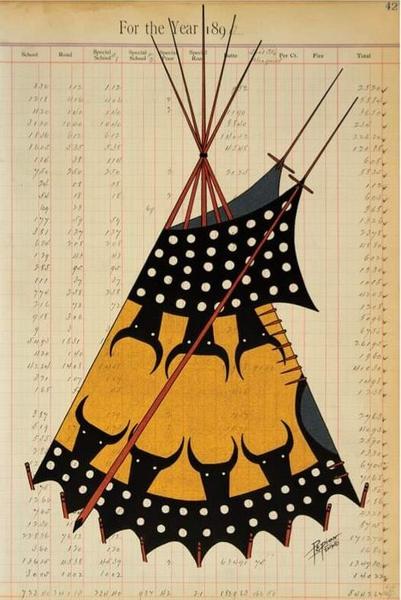
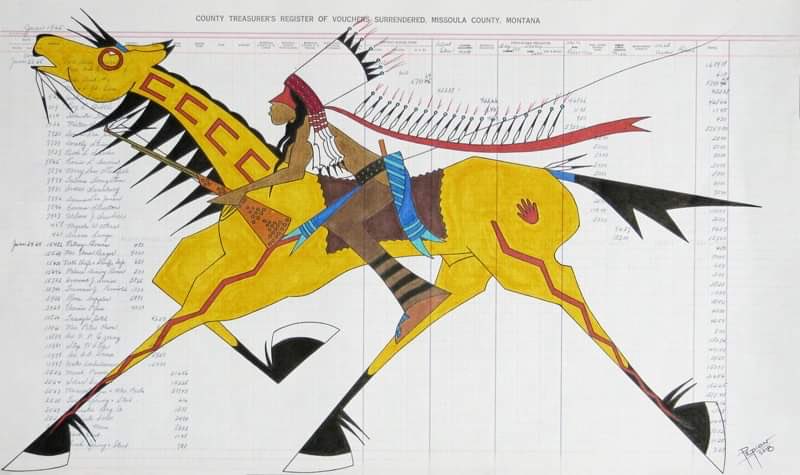
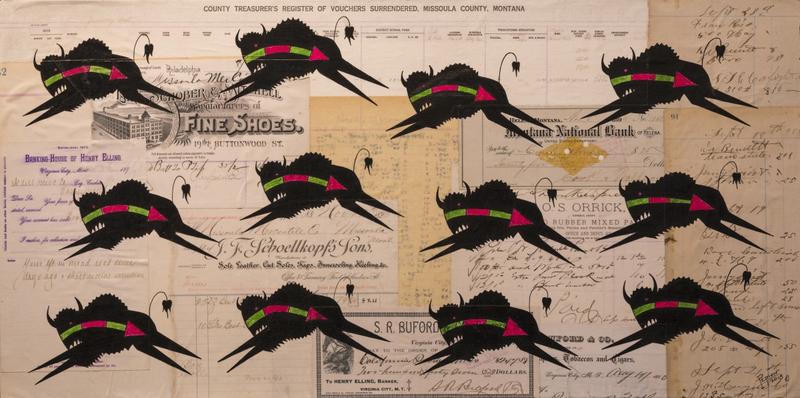
Artwork used here is by John Isaiah Pepion of the Piikuni Blackfeet Nation in Montana. The style is known as ledger art and was originally popular amongst Native American artists from Plains tribes in the 1800s.